

Sourced from Nashik: India’s Onion Capital
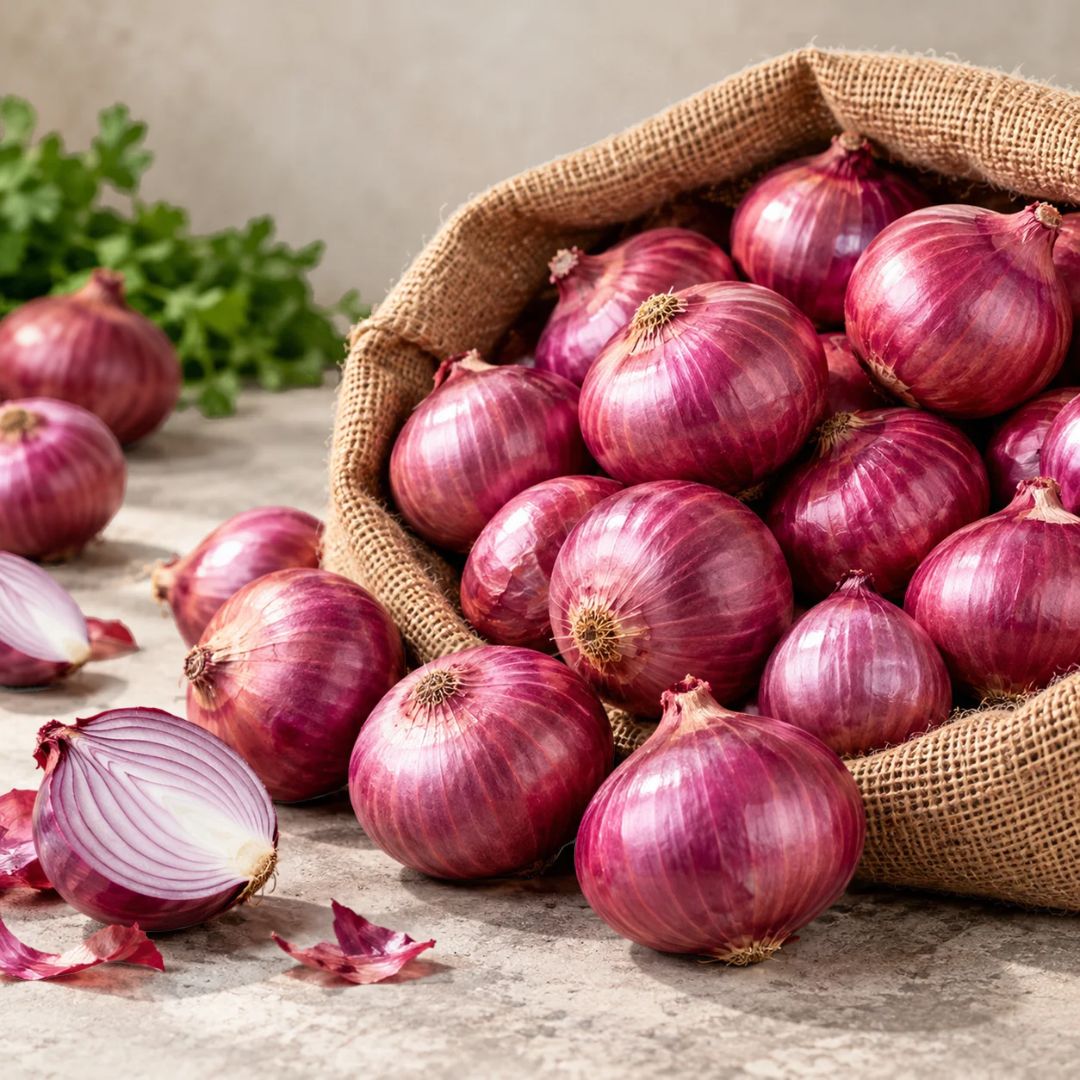
FRESH RED ONIONS from the Nashik belt of Maharashtra are recognized across international wholesale markets for their high dry-matter content, deep purple-red skin, and assertive culinary pungency. Nashik’s semi-arid microclimate, rich volcanic black soil, and proven agricultural practices yield bulbs with tight outer skin layers and dense internal rings. These natural characteristics make Nashik onions less prone to internal moisture loss, mechanical damage, and transit spoilage compared to onions grown in other regions. Krishi Global procures directly from accredited farming clusters and agricultural APMC mandis, guaranteeing fresh crop harvesting, consistent batch sorting, and full traceability.
Comprehensive Export Grading & Size Specifications
To meet specific culinary preferences, retail standards, and food-service requirements across the Middle East, Southeast Asia, Europe, and Africa, Krishi Global categorizes its FRESH RED ONIONS into standardized size brackets:
| Grade Category | Trade Classification | Bulb Diameter Range | Physical Characteristics & Best Applications |
| Small / Pickle | Golti / Golta | 25 mm – 35 mm / 25 mm+ | Round, compact, high pungency. Ideal for pickling, whole curry dishes, canning, and regional South Asian cuisine. |
| Medium | Commercial Medium | 40 mm – 55 mm / 45 mm+ | Balanced, uniform globe shape. The standard commercial export grade for international supermarket retail shelves and home cooking. |
| Large / Super | Big / Super / Jumbo | 50 mm – 80 mm / 60 mm+ | Large, fleshy bulbs with thick rings. Ideal for commercial food service, restaurant slicing, onion ring processing, and institutional catering. |
| Custom Sorted | Buyer Specific | Custom calibrated | Sorted to exact millimeter tolerances with specified neck dryness and skin-layer counts per contract requirements. |
Post-Harvest Curing, Grading, & Quality Control
Maintaining onion firmness and preventing transit spoilage requires meticulous post-harvest management. Krishi Global enforces rigorous handling protocols:
-
Natural Curing & Drying: Harvested bulbs undergo field-curing and forced-air drying to ensure outer skins turn papery and dry, and the necks fully seal to prevent microbial and fungal entry.
-
Mechanical Sorting & Destoning: Automated sizing screens and roller tables remove undersized bulbs, double-bulbs, thick-necked specimens, stones, and field soil.
-
Tight Outer Skins: Only bulbs with at least 2 to 3 intact, tight papery outer skin layers are selected, protecting the succulent inner fleshy scales from bruising and transit dehydration.
-
Zero Sprouting & Rot Tolerance: Consignments are thoroughly inspected to ensure zero active green shoots, no internal black mold (Aspergillus niger), and complete freedom from soft rot.
Commercial & Culinary Value
-
High Pungency & Flavor Retention: Nashik red onions contain elevated levels of natural allyl propyl disulfide and volatile sulfur compounds, delivering strong pungency when raw and deep caramelized sweetness when sautéed.
-
High Dry Matter & Extended Storage: A high percentage of natural soluble solids and dry matter gives these onions superior culinary yield and extended post-harvest shelf stability.
-
Food Processing & Dehydration: Widely utilized in commercial food processing lines for onion flake dehydration, onion powder milling, purees, frozen slices, and ready-to-cook bases.
Technical Specifications & Quality Parameters
| Parameter | Specification Standard |
| Product Name | FRESH RED ONIONS (Allium cepa) |
| Harvest Origin | Nashik Region, Maharashtra, India |
| Available Sizes | 25–35 mm (Golti), 40–55 mm (Medium), 50–80 mm (Big/Super) |
| Shape & Color | Globular to round; deep dark red to pinkish-purple outer skins |
| Pungency | Medium to High (characteristic pungent sulfur aroma) |
| Outer Skin Layers | 2 to 3 tight, dry papery skins intact |
| Moisture / Neck Status | Well-dried, tightly closed, thin necks (< 1.5 cm) |
| Foreign Matter | Nil (< 0.5% max field dust) |
| Defective Bulbs | Max 2% (cuts, doubles, or mechanical skin abrasions) |
| Shelf Life | 30 to 60 Days (in ventilated ambient storage) / up to 90 Days (in reefer cold storage) |
International Quality Assurance & Certifications
Krishi Global sorts, inspects, and exports fresh produce under strict compliance with global food safety standards:
-
APEDA Registered: Official authority for fresh agricultural produce export from India.
-
FSSAI Certified: Meets Indian national food safety and hygiene regulations.
-
Phytosanitary Clearance: Inspected and certified free from regulated quarantine pests, nematodes, and soil-borne pathogens.
-
US FDA Registered Facility: Cleared for import and commercial distribution across North American retail channels.
-
Pre-Shipment Inspection: Every consignment is inspected by government-approved authorities for size calibration, skin condition, and absence of rot.
Packaging Solutions: Breathable & Reefer Logistics
Fresh onions respire continuously and require packaging that prevents moisture condensation and heat accumulation:
-
Leno Mesh Bags (Red Poly-Mesh):
-
High-tensile, open-weave red leno mesh bags in 5 kg, 10 kg, 20 kg, 25 kg, and 50 kg capacities.
-
Open mesh construction allows maximum cross-ventilation, dissipating heat and condensation during sea transit.
-
-
Traditional Jute Bags:
-
Heavy-duty, breathable natural jute hessian sacks (25 kg and 50 kg) favored for specific regional markets.
-
-
Containerized Ocean Freight Logistics:
-
Ventilated Dry Containers: Shipped in standard GP containers with active side-ventilation for short to medium ocean voyages (Middle East, Southeast Asia).
-
Refrigerated (Reefer) Containers: Loaded in 40-ft High-Cube reefer containers maintaining temperature at +1°C to +3°C with 65–70% relative humidity and controlled air exchange (25–30 CMH) for long-distance transit (Europe, Americas).
-
Trade terms: FOB, CFR, and CIF from major Indian ports (Nhava Sheva / JNPT, Mumbai).
-
4. Frequently Asked Questions (FAQs)
Q: What makes Nashik red onions preferred over other origins for international export?
A: Nashik red onions possess higher dry-matter content, thicker fleshy scales, and tighter papery outer skin layers than onions grown in other regions. This natural structure provides higher tolerance against moisture loss, mechanical bruising, and transit rot, giving them a longer shelf life during ocean shipping.
Q: How do you prevent onions from sprouting or rotting during ocean shipping?
A: Sprouting occurs when onions are exposed to moisture, high humidity, and warm temperatures. We ensure that our onions are thoroughly field-cured until the necks are dry and sealed. For voyages exceeding 10–14 days, we utilize 40-foot reefer containers set at +1°C to +3°C with humidity levels calibrated between 65% and 70% to keep the bulbs in a dormant state.
Q: What is the difference between Golti, Medium, and Super sizes?
A: The difference is bulb diameter:
-
Golti (25–35 mm): Small, round onions commonly used for pickling, stews, and whole-bulb cooking.
-
Medium (40–55 mm): Standard commercial grade popular for household cooking and retail supermarket sales.
-
Super / Big (55–80 mm): Large onions preferred by commercial restaurants, institutional food service, and industrial slicing facilities.
Q: What is the shelf life of FRESH RED ONIONS after arrival?
A: Under well-ventilated, dry, and cool storage conditions (15°C–20°C with 60–70% humidity) away from direct sunlight, Nashik red onions maintain quality for 30 to 60 days. In dedicated cold storage facilities (+1°C to +3°C), they remain sound for up to 90 days.
Q: What is the Minimum Order Quantity (MOQ) for onion export consignments?
A: Our standard MOQ is one 20-foot or 40-foot Full Container Load (FCL):
-
A 20-ft container holds approximately 12 to 14 metric tons.
-
A 40-ft reefer container holds approximately 28 to 29 metric tons packed in 25 kg mesh bags.
Q: What shipping and phytosanitary documents accompany each export consignment?
A: Every consignment is dispatched with a government-issued Phytosanitary Certificate, Certificate of Origin, Commercial Invoice, Packing List, Bill of Lading, and an independent pre-shipment surveyor inspection report.